
Red Hat has been recognized as a Leader in the Gartner® Magic Quadrant™ for Server Virtualization Platforms for Red Hat OpenShift Virtualization. We are excited by this recognition, as we believe it reflects Red Hat OpenShift Virtualization as the modern virtualization capability of Red Hat OpenShift to run and manage virtual machines (VMs) alongside cloud-native workloads on a unified hybrid cloud foundation. This recognition is driven by Red Hat’s Completeness of Vision and Ability to Execute.
Red Hat OpenShift Virtualization is included within all Red Hat OpenShift self-managed editions and available across all major public cloud providers including AWS, Microsoft Azure, Google Cloud, IBM Cloud, and Oracle Cloud. Red Hat OpenShift Virtualization Engine is a dedicated, virtualization-focused edition of Red Hat OpenShift that allows organizations to exclusively run VMs with the option to expand into cloud-native applications over time.
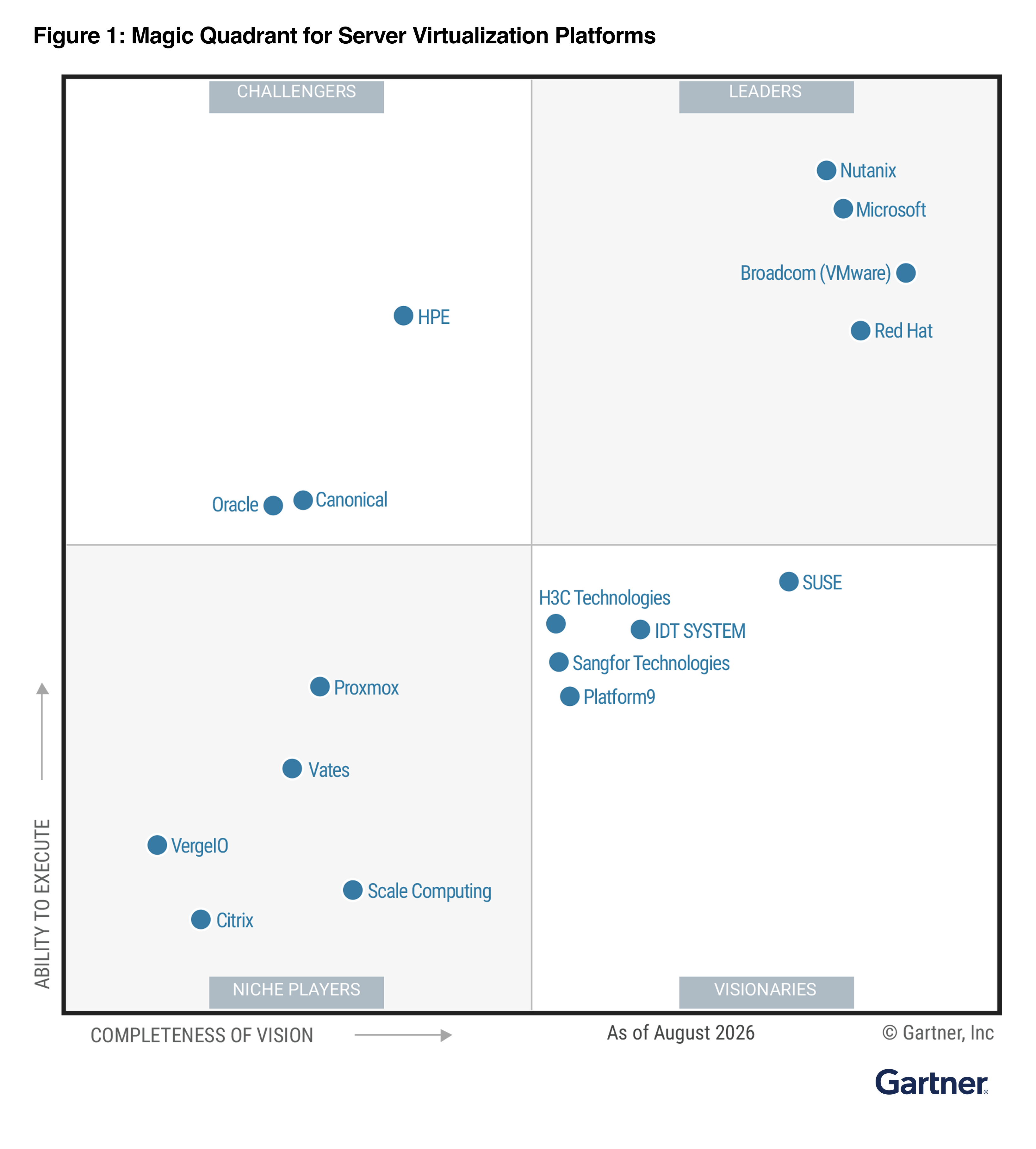
Source: Gartner, “Magic Quadrant for Server Virtualization Platforms,” September 2026. Red Hat is positioned as a Leader in the upper-right quadrant, which we believe demonstrates strong execution and vision.
To help further explain the evaluation of the Gartner Magic Quadrant from our point of view, we’re answering some of the most frequently asked questions.
What is the Gartner Magic Quadrant?
“Magic Quadrant reports are a culmination of rigorous, fact-based research in specific markets, providing a wide-angle view of the relative positions of the providers in markets where growth is high and provider differentiation is distinct. Providers are positioned into four quadrants: Leaders, Challengers, Visionaries, and Niche Players. Magic Quadrants help you get quickly educated about a market’s competing technology providers and their ability to deliver on what end users require today and in the future.
How was this Magic Quadrant assessed? What was the criteria for inclusion?
“Gartner defines server virtualization platforms as a technology solution that decouples operating systems and workloads from the underlying physical infrastructure. This enables multiple isolated virtual environments to run concurrently across a cluster of hosts while providing centralized management, automation and resource orchestration.
Server virtualization platforms can be used by enterprises to optimize IT infrastructure and improve service levels within data centers and remote locations. Service providers often
use a server virtualization platform as an embedded component of their infrastructure as a service (IaaS) offerings and/or for delivering a hosted server virtualization platform.”
According to Gartner, the mandatory features for the server virtualization platforms market include:
- Hypervisor-based virtualization: Provision of a Type 1 hypervisor that acts as a virtual machine (VM) monitor for hardware resources, including processor and memory. It allows multiple workloads to run simultaneously as VMs on abstracted hardware. Must support x86-based server hardware.
- Live migration: The ability to move a running VM to another virtualization host without downtime (referred to as “live migration”).
- Security: Role-based access management and integration with external IAM solutions.
- Management and administration: Graphical user interface (GUI) for administration of virtual infrastructure, which includes:
- VMs, hosts, clusters and resource pools
- Application programming interface (API) for third-party integration of and/or with the server virtualization platform
- Command line interface (CLI) for automation of the server virtualization platform
- Storage: Compatibility with storage protocols such as iSCSI, Fibre Channel, NFS and NVMe over TCP, and virtual disks.
- Virtual networking: Support for a virtual network switch that allows VMs to communicate on a specific server or with other servers.
Why is this significant to us?
Gartner defines Leaders as those who execute well against their current vision and are well positioned for tomorrow. To Red Hat, this recognition underscores our commitment to helping organizations escape rising virtualization costs and vendor lock-in. By enabling teams to migrate existing VMs with low disruption onto a modern, hybrid cloud foundation, OpenShift Virtualization delivers immediate operational stability with a clear, low-risk path to cloud-native innovation, containers, and AI on their own timeline.
Learn more about Red Hat OpenShift as a Server Virtualization Platform
A full copy of the Gartner Magic Quadrant for Server Virtualization Platforms can be downloaded here.
Gartner disclaimer:
Gartner, Magic Quadrant for Server Virtualization Platforms, Tony Harvey, Daniel Bowers, Paul Delory, Tony Iams, Owen Marino, 14 September 2026.
Gartner and Magic Quadrant are trademarks of Gartner, Inc. and/or its affiliates.
Gartner does not endorse any company, vendor, product or service depicted in its publications, and does not advise technology users to select only those vendors with the highest ratings or other designation. Gartner publications consist of the opinions of Gartner’s business and technology insights organization and should not be construed as statements of fact. Gartner disclaims all warranties, expressed or implied, with respect to this publication, including any warranties of merchantability or fitness for a particular purpose.
About the author
Carolyn May is a Product Marketing Manager at Red Hat, specializing in OpenShift, the leading hybrid cloud application platform powered by Kubernetes. With a background in sales, Carolyn spearheads initiatives aimed at highlighting the value of OpenShift.
More like this
Friday Five — October 9, 2026 | Red Hat
Scale enterprise analytics by running Cloudera Data Platform with OpenShift Virtualization
Can agentic AI patch the internet?
Random Acts Of Automation | Compiler
Browse by channel

Automation
The latest on IT automation for tech, teams, and environments

Artificial intelligence
Updates on the platforms that free customers to run AI workloads anywhere

Open hybrid cloud
Explore how we build a more flexible future with hybrid cloud

Security
The latest on how we reduce risks across environments and technologies

Edge computing
Updates on the platforms that simplify operations at the edge

Infrastructure
The latest on the world’s leading enterprise Linux platform

Applications
Inside our solutions to the toughest application challenges

Virtualization
The future of enterprise virtualization for your workloads on-premise or across clouds
